
A MR. TANKLESS FIELD GUIDE / THEN & NOW
The history of
water heaters.
From Roman bath furnaces to today’s wall-mounted tankless systems, hot water has always been an engineering story. Here’s how we got here—and how to help modern equipment last.
01 / THE ORIGINS
Hot water has a long history.
There is no defensible single “first water heater on Earth.” People heated water long before written engineering records. Among the earliest well-documented purpose-built systems were ancient Roman bathhouses, where a furnace could warm a tank supplying a hot bath. The recognizable domestic gas water heater arrived much later, in Europe.
ANCIENT ROME
A furnace heats the bath
Roman bathhouses used a hypocaust to circulate hot air below floors; the same furnace could heat water held in a tank for the hot bath. This was a fixed building system, not a household appliance. English Heritage ↗
1868 · ENGLAND
Hot water on demand
Benjamin Waddy Maughan’s gas “geyser” is widely credited as an early domestic instantaneous water heater. An example made by Maughan’s Patent Geyser Co. survives in London’s Science Museum collection. Science Museum ↗
1889 · UNITED STATES
Automatic storage takes hold
Norwegian-born engineer Edwin Ruud developed an automatic gas storage water heater after coming to America. The technology put a controlled supply of stored hot water within reach of more homes. Ruud history ↗
20TH CENTURY
The familiar tank becomes standard
Insulated storage tanks, thermostats, safety controls and gas or electric heat made domestic hot water an everyday expectation. The common atmospheric-vent gas tank is one version of that broader storage-heater family.
TODAY
Tankless returns to the original idea
Modern sensors and heat exchangers bring instantaneous heating into a compact, controlled appliance. There is no big reserve tank to keep hot between uses; proper sizing and maintenance matter.
02 / A SHIFT IN AMERICAN HOMES
The tank still leads.
Tankless is growing.
U.S. Energy Information Administration household surveys document a clear rise in homes reporting a tankless main water heater. These are survey snapshots of installed equipment, not annual sales or a forecast.
MAIN WATER HEATER IN U.S. HOMES
- Tankless
- Other systems
~1.1 million homes
3.0 million homes
8.03 million homes
Percentages divide reported tankless main heaters by all occupied U.S. homes in each survey year and are rounded. “Other systems” includes storage and central water heating of all fuels; EIA does not identify atmospheric-vent gas tanks separately in this series. Source: EIA 2005, 2015, 2020 RECS. No annual values have been interpolated.
Potential energy-efficiency advantage for gas on-demand water heaters in homes using no more than 41 gallons of hot water a day, compared with conventional storage.
DOE estimate for gas units in high-use homes around 86 gallons a day. Actual savings depend on model, fuel, draw pattern and installation.
Possible service life for a well-maintained tankless heater; a typical storage heater lasts roughly 10–15 years. No individual unit is guaranteed to reach that age.
Efficiency and lifespan figures: U.S. Department of Energy Energy Saver Guide ↗. Energy efficiency is not the same as a guaranteed reduction in your utility bill.
03 / INSIDE THE UNIT
Open the tap.
Make the heat.
Unlike a storage tank, a tankless heater responds to water flow. Cold water moves through a heat exchanger, a burner or electric element transfers heat, and hot water exits to the fixture. A gas model needs appropriate venting and gas supply; an electric model needs suitable electrical capacity.

01
Flow starts
A sensor detects the call for hot water.
02
Heat transfers
The heat exchanger warms the moving water.
03
Demand ends
Heating stops when the tap closes.
04 / CHOOSE THE FUEL THAT FITS
Three ways to go tankless.
Natural gas is often a practical whole-home choice where a suitable gas service already exists. The lowest total cost depends on local utility rates, fuel availability, equipment size, venting and upgrade costs. We assess the actual house before recommending one.
NG
A FREQUENT WHOLE-HOME FIT
Natural gas
Strong heating capacity for multiple fixtures, with condensing models able to recover more heat from exhaust. It needs correctly sized gas piping, approved venting and often a condensate drain.
Your home already has suitable gas service.
LP
Propane
Similar combustion-based operation when utility gas is unavailable. A propane storage tank, deliveries, fuel pricing and approved venting enter the overall cost.
A home lacks a natural gas connection.
E
Electric
No combustion vent, often compact for a sink or modest demand. Whole-home units can require substantial electrical power, especially when incoming New Jersey water is cold.
Electrical capacity and the intended flow rate align.
Tankless provides continuous hot water within its rated flow and temperature rise. Multiple simultaneous showers still require correct sizing. Compare each candidate’s UEF and delivered gallons per minute; current ENERGY STAR criteria use UEF, a standardized efficiency measure.
05 / MAKE IT LAST
Good water.
Longer life.
In parts of northern New Jersey, hard water leaves calcium and magnesium scale behind. The right treatment starts with the local water report and, where useful, an actual hardness test. Mr. Tankless pairs suitable tankless installations with water treatment and accessible service valves.
One option is the 3M Aqua-Pure AP430SS scale-inhibition system on the cold-water feed. It doses polyphosphates to help keep hardness minerals from depositing on hot surfaces. It is not a calcium-catching filter or a substitute for a water softener where the heater maker requires one. Its AP431 cartridge generally needs replacement every six months or sooner if flow falls. Manufacturer details ↗
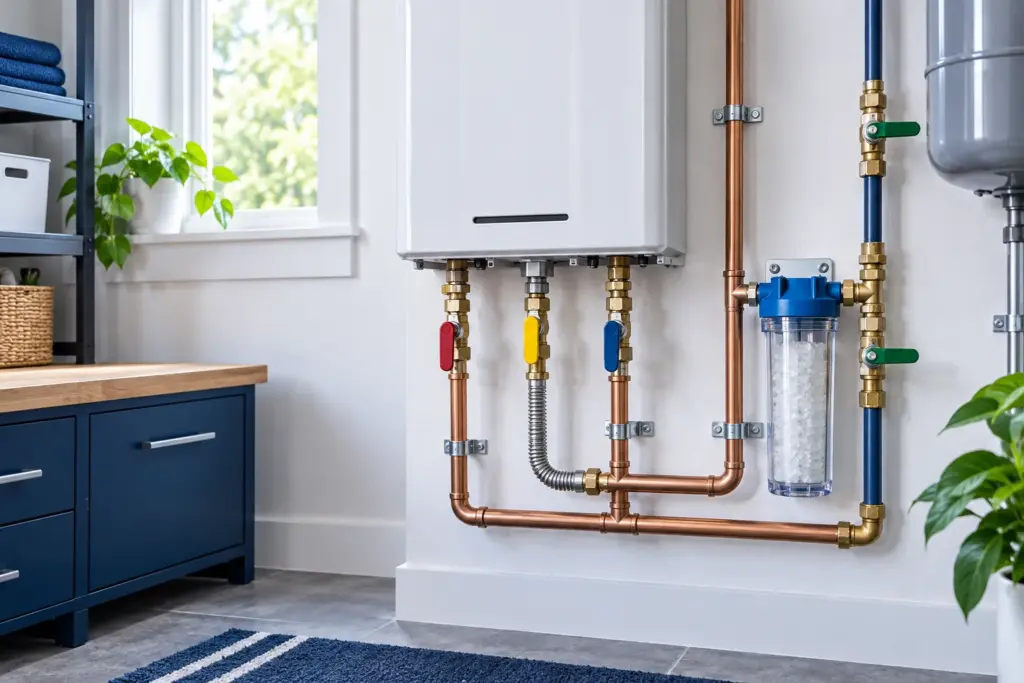
THE COFFEE-MACHINE ANALOGY
Scale can build up wherever water is heated.
Like descaling a coffee maker, professional tankless flushing circulates a manufacturer-approved solution through the heat exchanger to remove mineral deposits. The procedure and frequency depend on the model, water quality and use.
A sensible service visit checks:
- Heat exchanger flushing and inlet-screen cleaning as specified by the manufacturer.
- Scale-control cartridge age, water hardness and treatment suitability.
- Gas combustion, venting, condensate and error history where applicable.
- Flow rate, outlet temperature, leaks and accessible isolation valves.
Ignoring scale may restrict flow, reduce performance and shorten service life. The DOE’s technical guide says flush intervals can range from twice a year to once every three years, depending on the manufacturer and conditions. DOE technical guidance ↗
THE RIGHT SYSTEM FOR YOUR HOUSE
Hot water has evolved.
Your installation should, too.
Talk with Mr. Tankless about water hardness, fuel choice, sizing, installation or a maintenance visit in northern New Jersey.
Mr. Tankless · New Jersey plumbing license #9366